27 October 2026
When training looks real: lessons from HITTER in Rome
Dr Pieter Marais shares a look at realistic major-trauma simulation in Rome, where he serves as teaching faculty. What do these exercises teach, and why does practising difficult decisions matter?

A medical team gathers beside a military vehicle. Equipment is ready, the casualty looks seriously injured, and the team has to decide what to do next. The scene looks like an emergency. But it is a training exercise.
At the HITTER major-trauma programme in Rome, realistic simulation gives doctors a chance to rehearse difficult situations without putting a patient at risk. Dr Pieter Marais is there as an expert instructor and teaching faculty member, helping participants practise the skills and decisions needed in a major trauma emergency.
Why make a training exercise look so real?
Knowing what to do in theory is important. Doing it while several things demand attention at once is a different challenge.
In a serious injury, the team may need to assess breathing, recognise major bleeding, call for help and arrange urgent treatment almost simultaneously. Simulation brings those demands together in a controlled setting.
Some exercises use moulage: carefully made simulated wounds, make-up and props. The aim is not to shock. It is to give the team believable clues to interpret, while practising how to communicate and work together under pressure.
The Rome footage includes an abdominal evisceration scenario, in which bowel appears to protrude through an abdominal wound. It is a simulated injury, not footage of an injured patient. We have not included the graphic close-up here.
What is HITTER?
HITTER is an advanced major-trauma training programme hosted by INTUBATI EM in Rome. The course is accredited by the Royal College of Surgeons of England. Dr Marais participates as teaching faculty, not as a student attending the course.
The programme brings practical skills and clinical decision-making into the same exercise. Participants practise responding to severe injuries, using the available equipment and recognising when specialist intervention is needed.
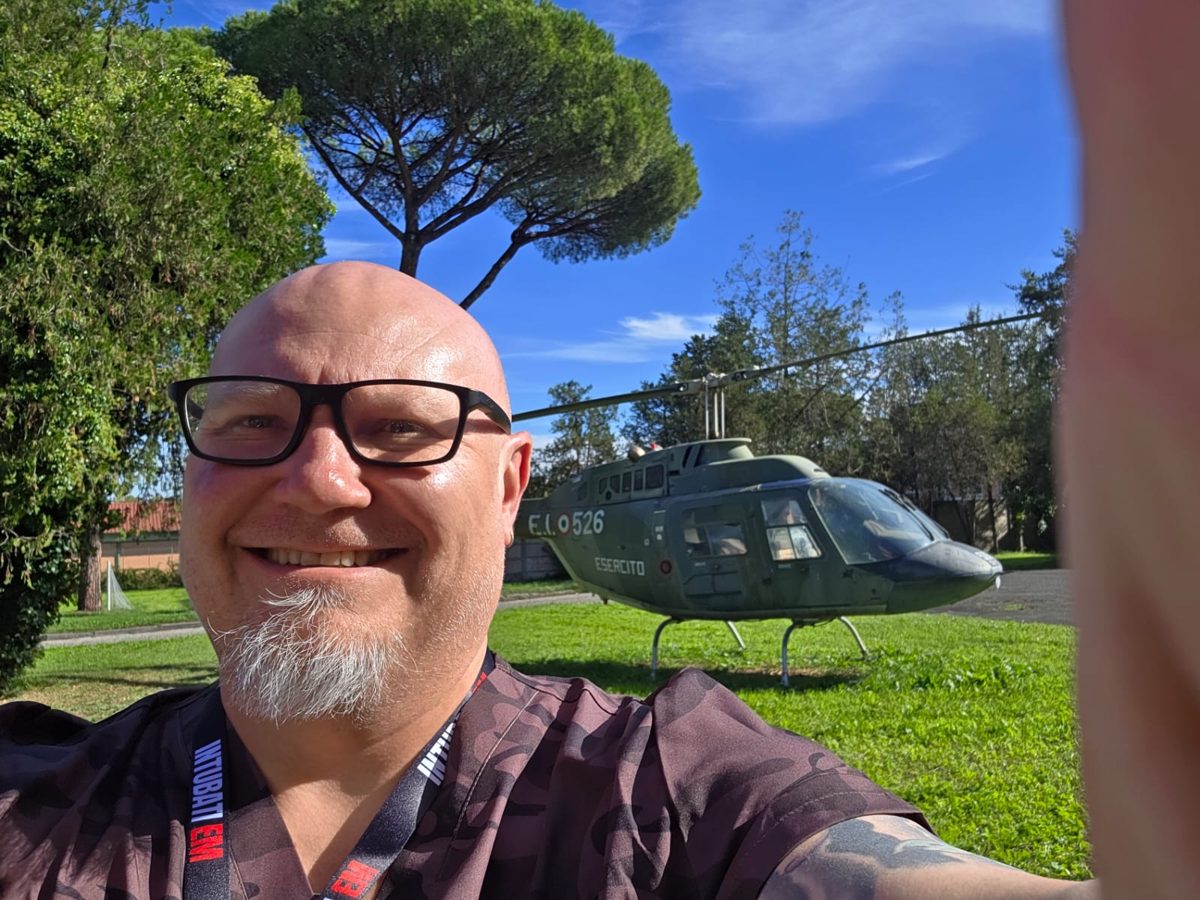
Dr Marais at the Rome training venue. The military setting forms part of the course environment.
Dr Marais's skills station: controlling severe pelvic bleeding
At the Rome course, Dr Marais teaches the preperitoneal pelvic packing skills station. The name is technical, but its purpose is straightforward: to help control severe bleeding in selected patients with life-threatening pelvic injuries.
In this operation, a surgeon places surgical packs in the space around the injured pelvis to apply pressure and help limit bleeding. It is one part of a wider emergency response, which may also involve resuscitation, stabilising the pelvis and other treatments to control the source of bleeding.
It is not the right treatment for every pelvic injury. The team must judge the patient's condition, the likely source of bleeding and the resources available. That is why a skills station needs to teach decision-making as well as the operation itself.
Watch Dr Marais teaching the pelvic packing skills station on the Practice page. The demonstration uses a training model. Video credit: Dr La'eeqa Kajee.
What does “damage-control surgery” mean?
In ordinary planned surgery, the aim is usually to complete the intended operation in one sitting. In a critically injured patient, that may not be safe.
Damage-control surgery prioritises the immediate threats, particularly severe bleeding and contamination. A shorter initial operation may be followed by intensive care and a further operation once the patient's condition allows it.
It is a staged approach for selected emergencies, not a shortcut and not a description of routine elective surgery.
The important part happens after the scenario, too
A realistic exercise creates the situation. The review afterwards helps turn it into learning.
In simulation training, teams can discuss what they noticed, which decisions helped and where communication could have been clearer. A missed cue can be examined and the exercise repeated. That opportunity is much harder to create during a real emergency.
- Was the most urgent problem recognised?
- Did everyone understand their role?
- Were decisions communicated clearly?
- What would the team do differently next time?
Why this matters to patients back home
Most patients seeing Dr Marais in Johannesburg are not facing a major trauma emergency. They may be discussing a hernia, gallbladder disease, bowel symptoms or another planned procedure.
The situations are different, but some principles are shared: careful preparation, sound anatomical knowledge, clear teamwork and knowing when to change the plan.
Teaching and simulation provide opportunities to revisit those principles. They do not guarantee an outcome, and international course participation is not a substitute for discussing your own condition, treatment options and risks with your surgeon.
Dr Marais's main surgical base is Netcare Olivedale Hospital, with operations also arranged at Netcare Bedford Gardens Hospital and Cure Day Hospitals as appropriate for the individual patient.
A look behind the scenes, not a treatment guide
This article explains the training shown in the Rome updates. It is not a guide to treating a traumatic injury. If someone is seriously injured, contact emergency services immediately.
For more about Dr Marais's background and international teaching role, visit the Practice page. For a planned consultation or a referral, contact the practice.