Robotic Surgery (da Vinci) in Johannesburg
Robotic surgery is a refinement of laparoscopic (keyhole) surgery. The surgeon operates seated at a console a few metres from the patient, controlling miniaturised wristed instruments through the same small incisions as conventional laparoscopy. The robot never operates on its own — every movement is the surgeon's, translated in real time with tremor filtered out.
Performed by Dr Pieter Marais at Johannesburg Surgical Hospital, Randburg, Johannesburg.
What it involves
Dr Marais is a certified da Vinci console surgeon on the Intuitive Surgical robotic platform. The da Vinci system provides 3D high-definition magnified vision and EndoWrist instruments — tools that bend and rotate the way a human wrist does, but inside the abdomen. It is the same minimally invasive philosophy as laparoscopy, extended to anatomy where fine wristed articulation and depth perception make a real difference.
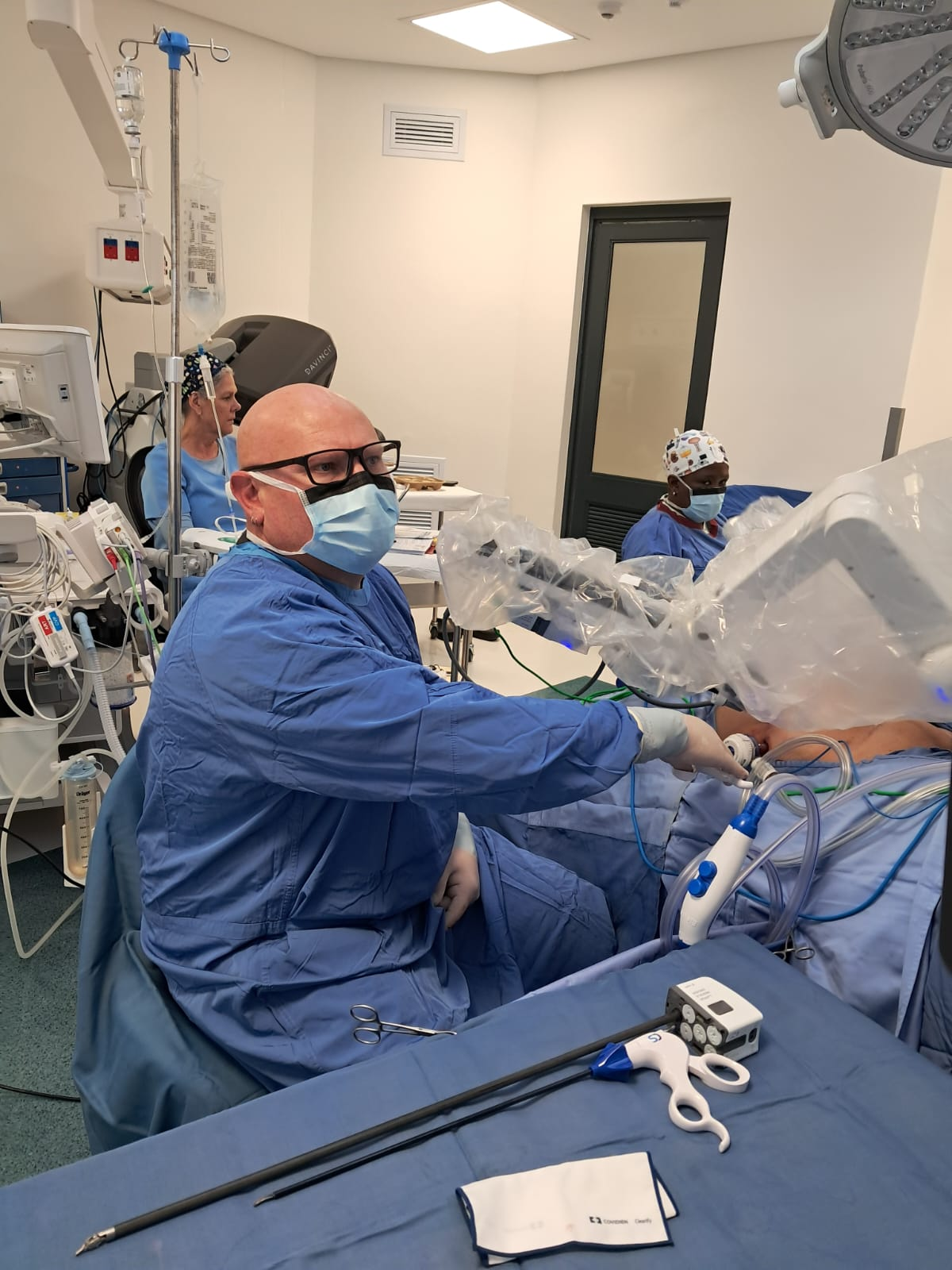
A da Vinci operation has three components: the surgeon console (where the surgeon sits, hands in the controls, eyes on a stereoscopic 3D view), the patient cart (four robotic arms docked to laparoscopic ports on the patient), and the vision cart (the imaging and processing system linking them). The surgeon's hand movements are scaled and translated to instrument tips inside the body, with natural hand tremor filtered out electronically.
Certification as a da Vinci console surgeon is a structured pathway: didactic training on the platform, simulation and cadaveric work, proctored initial cases, and documented case volumes before independent practice. It is a specific qualification on top of specialist surgical training — not something every surgeon offering laparoscopic surgery holds.
Dr Marais is trained on the da Vinci system (also written DaVinci) built by Intuitive Surgical — the most widely used robotic surgery platform worldwide, with a track record across general, hernia, colorectal, urological and gynaecological surgery.
For the patient, the experience and recovery closely mirror laparoscopic surgery: several small (5–12 mm) incisions, same-day or one-night hospital stay for most procedures, and a return to desk work within a week for straightforward cases. Where the robot earns its place is inside the operation — better visualisation and finer articulation in tight anatomical spaces mean a more precise repair.
When it's indicated
The clearest current benefit is in complex hernia work — inguinal, ventral, incisional and hiatal repair — where the robot's wristed instruments help with delicate dissection and precise mesh placement. This is particularly valuable in overweight and obese patients (where open repair carries higher wound-infection and recurrence rates), in recurrent hernias, and in larger defects requiring robotic transversus abdominis release (TAR) component separation. Select upper-GI, adrenal and endocrine cases are also candidates.
The approach
The robot is a tool, not a decision. The right operation for you is the one that gives the safest, most durable result — sometimes that's robotic, sometimes conventional laparoscopy, occasionally open. Dr Marais discusses honestly when a robotic approach genuinely changes the outcome for your case and when it doesn't.
Recovery
Broadly the same as laparoscopic surgery: same-day or one-night stay for most procedures, walking within hours, desk work within a week, gym at three to four weeks. Small port-site incisions heal to short lines that fade over months.
From the operating room
Robotic Surgery FAQ
- Does the robot operate on its own?
- No. The da Vinci system has no autonomous function. Every movement of every instrument is controlled directly by the surgeon at the console — the robot is a set of very precise arms, not a decision-maker. Think of it as advanced instrumentation, not artificial intelligence.
- Is robotic surgery safer than laparoscopic surgery?
- Not automatically. For straightforward laparoscopic operations (like uncomplicated gallbladder removal), conventional laparoscopy is quicker and equally good. Where the robot helps is in complex hernia repair, recurrent surgery, obese patients, and delicate reconstruction — cases where wristed instruments and 3D vision genuinely change what's possible.
- Which of my procedures can Dr Marais do robotically?
- Inguinal, ventral, incisional and hiatal hernia repair are the strongest current indications. Select upper-GI and adrenal cases are also candidates. Dr Marais will tell you honestly at consultation whether a robotic approach adds value for your specific case.
- Is robotic surgery covered by medical aid?
- Most South African medical aids cover the surgical procedure at the standard rate. There is sometimes a facility fee difference for robotic use — the practice provides a written quote before booking so you know exactly what's covered.
- Where is the da Vinci system used?
- Dr Marais operates on the da Vinci platform at Netcare Olivedale Hospital in Randburg, Johannesburg and partner facilities in Johannesburg equipped with the system. Robotic cases are scheduled around theatre availability of the platform.
Discuss robotic surgery with Dr Marais
Send a short enquiry and the practice will be in touch during weekday office hours. Consultations take place at Johannesburg Surgical Hospital.
Explore related surgery
Colorectal Surgery (Colectomy, Hemicolectomy, Sigmoidectomy, Proctocolectomy)
Robotic and laparoscopic colon and rectal resection for diverticular disease, IBD and colorectal cancer.
16Rectopexy & Sacrocolpopexy (Pelvic Floor Repair)
Robotic and laparoscopic repair of rectal prolapse and vaginal vault prolapse.
02Inguinal Hernia Repair
Groin hernia repair — laparoscopic (TEP/TAPP) and open techniques.
12Hiatal Hernia Repair
Laparoscopic repair of sliding and paraoesophageal hiatal hernias.
Next procedure
15Colorectal Surgery (Colectomy, Hemicolectomy, Sigmoidectomy, Proctocolectomy) →Robotic and laparoscopic colon and rectal resection for diverticular disease, IBD and colorectal cancer.